01Fintech backs DANA 💳. China-ASEAN Investment Council formed 🤝. SEA green economy’s $290B reality check 🌱

Dear subscribers,
Southeast Asia’s green economy reached US$290 billion in 2025, on track for US$430 billion by 2030, but over 35% of announced green capex never materialized. This week, we dive deep into the conversion gap holding back the region’s energy transition, plus 01Fintech’s investment in DANA, Zankore’s US$3.1 billion loan for NVIDIA GPU infrastructure, and Indonesia’s plan to require marketplaces to collect Article 22 income tax.

Let’s get into it.
Best regards,
The DailySocial Team
Here is a roundup of interesting updates from Indonesia’s startup ecosystem over the past week that you shouldn’t miss:
01F Group’s growth-stage fintech arm, 01Fintech, has invested in Indonesian digital financial platform DANA to support its expansion across payments and financial services. The partnership will focus on strengthening DANA’s platform, widening credit and working-capital access for MSMEs, expanding services such as micro-insurance and digital savings, and exploring more efficient cross-border payments for Indonesian users and merchants. [Read more]

DANA’s CEO Vincent Iswara (center) in their AI signature event / DANA Indonesia’s tax authority plans to require designated marketplaces to collect Article 22 income tax from domestic sellers starting November 1, 2026, subject to each platform’s readiness. The mechanism, governed by Finance Ministry Regulation No. 37/2025, will initially cover Tokopedia, Shopee, Lazada, and Blibli, shifting tax collection from individual sellers to the platforms. [Read more]
Indonesia-focused AI platform Zankore has signed a senior term loan facility of up to US$3.1 billion to finance an initial 100 MW deployment of NVIDIA GPU infrastructure for AI cloud services in Indonesia and Southeast Asia. The company aims to reach approximately 200 MW by the first half of 2027 and ultimately develop 1 GW of NVIDIA DSX AI Factory capacity, backed by a lending syndicate led by Citi, ING, Natixis CIB, Qatar National Bank, and UOB. [Read more]
Vietnamese mobility company Green SM has launched its electric motorcycle ride-hailing service in Jakarta, adding a new competitor to Gojek, Grab, Maxim, and inDrive. The service is supported by the company’s developing charging and battery-swapping network, following Green SM’s earlier electric taxi operations in Jakarta and expansion to several Indonesian cities. [Read more]
BSA Logistics, a Waresix business unit, secures Rp75 Billion vessel financing. Through its subsidiary Beruang Maritim Indonesia, publicly listed BSA Logistics Indonesia has obtained a 60-month term loan facility from Bank OCBC to support vessel purchases and logistics expansion. The facility is secured by first-ranking mortgages over five tugboats and five barges, alongside a corporate guarantee from controlling shareholder Tiga Beruang Kalifornia. [Read more]

Regional dynamics could also have a direct bearing on Indonesia’s startup landscape. Here’s a rundown of the latest developments:
Sovereign Funds Launch China-ASEAN Investment Council.
Six sovereign and pension institutions from China, Southeast Asia, and Azerbaijan have launched the China-ASEAN Joint Investment Council, convened by China Investment Corporation with CGS International as secretariat. The non-capitalised forum will focus on capital alignment, research and knowledge exchange, and leadership dialogue, building on the US$520 million first close of the Galaxy Orientis China-ASEAN Investment Program while leaving investment decisions to each member institution.CATL Commits US$167 Million to Venture Capital Fund.
CATL’s wholly owned subsidiary Ningbo Wending plans to invest 1.12 billion yuan, or approximately US$167 million, in the Xiamen Times Yiyuan Venture Capital Fund for a 19.4175% interest. The related-party investment highlights CATL’s growing use of fund structures, alongside its planned green fund with Indonesia’s Investment Authority and CMBI targeting opportunities across the electric-vehicle value chain.
Bain & Company and Standard Chartered’s newly released Southeast Asia’s Green Economy 2026: The New Calculus values the region’s green economy at roughly US$290 billion in 2025, on track for US$430 billion by 2030 at 8 to 9% annual growth. The bigger story is the shift in logic behind that number: capital no longer flows on climate ambition alone. Amid policy fragmentation and geopolitical volatility, investors now back projects on energy security, growth, and standalone commercial returns, what the authors call “the new calculus.”
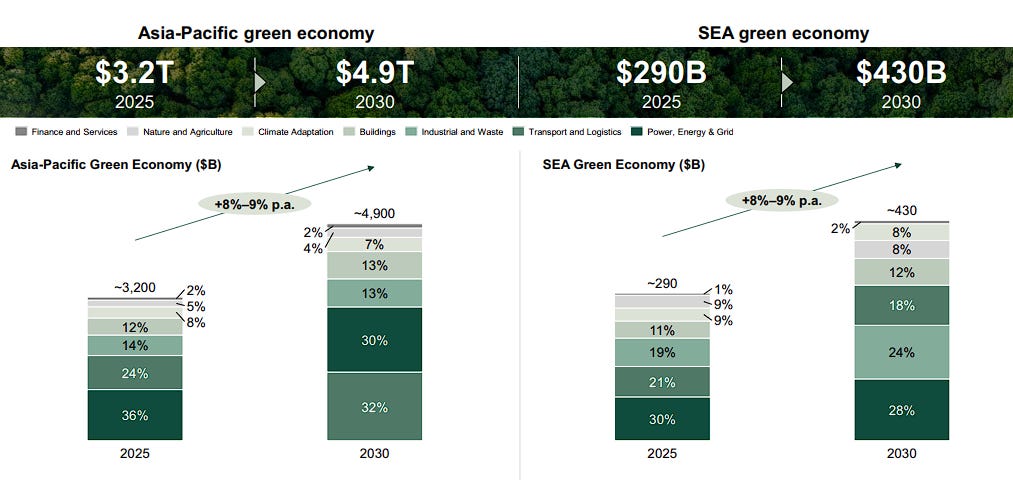
Follow the money and the pattern is stark. Of the ~US$40 billion in green capex deployed annually across SEA-6 in 2021 to 2025, about 80% went to just two sectors: power and grid (~50% , ~US$20 billion) and the EV value chain (~30%, ~US$11 billion), where demand is real, creditworthy, and not wholly policy dependent. Sectors that lean primarily on abatement economics, from carbon markets to sustainable aviation fuel, keep progressing, but at a pace set by policy and pilot capital rather than commercial pull.
The region’s binding problem is not capital, it is conversion. More than 35% of announced green capex in 2021 to 2025 never materialized, one of the weakest conversion rates among peer markets. Of the ~US$540 billion announced for power and EV value chains through 2030, only ~US$315 billion is likely to be deployed under current market conditions. Indonesia illustrates the gap: over US$14 billion in announced battery investment against roughly US$5 billion realized, plus marquee cancellations like BASF-Eramet’s US$2.6 billion nickel refinery after nickel prices fell more than 70% from their 2022 peak. Bain estimates that fixing system constraints, from grid access to bankable procurement (DPPAs) and permitting, would unlock an additional ~US$80 billion, a 25% uplift.
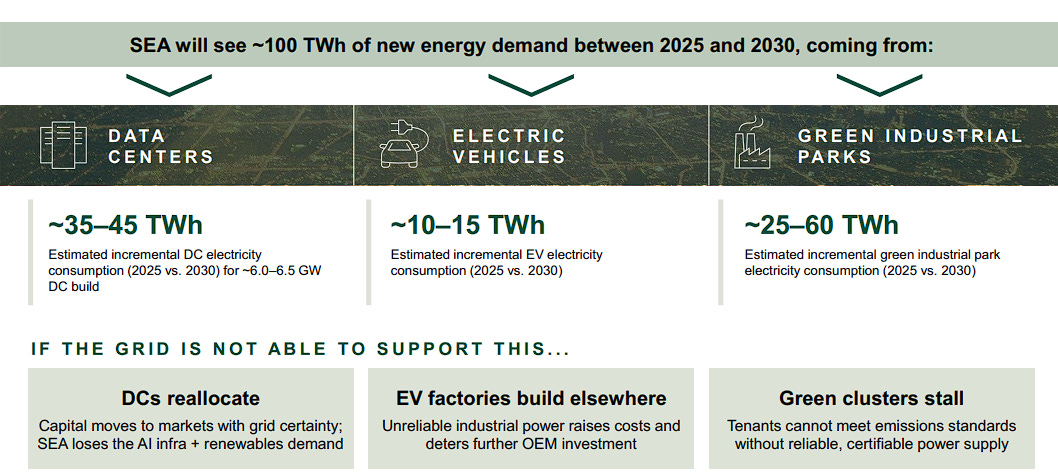
What makes the window urgent is a demand wave: more than 100 TWh of new electricity load by 2030, from data centers (35 to 45 TWh, with SEA DC capacity set to triple), green industrial parks (25 to 60 TWh, with 90 clusters today versus 45 in 2021), and EVs (10 to 15 TWh; four of the world’s top 15 EV markets are now in SEA). The grid is the shared chokepoint: ~90% of surveyed DC operators cite grid connection delays as a key constraint on further investment. Left unfixed, data centers reallocate, OEMs build elsewhere, and green clusters stall.
The report reads as a map of where the real opportunity sits: in the plumbing. Grid technology, storage, charging and energy management, industrial power solutions, and anything that converts announced capital into built assets serves buyers who must have the product on timelines that cannot slip. The clock matters: hyperscalers and automakers are locking in platform decisions in the 2025 to 2028 window, and large loads need power within 24 to 36 months. SEA still captures under 2% of global EV and battery production while ~70% of EV value leaks outside the region. The teams that close the conversion gap, rather than announce ambition, will define the next cycle.